Glasses vs Contacts (2026): Cost, Care and Who Each Suits
Eyeglasses vs contacts compared on cost, prescription, care and risks – using published store prices and the National Eye Institute's contact lens guidance, with a worked annual cost example.
Disclosure: We may earn a commission if you buy through links on this page, at no extra cost to you. It never affects our ratings. How we make money.
On this page
Short answer: Neither is “better” for everyone. Glasses are mostly a one-time purchase (advertised from about $6 online, or $95 at Warby Parker including prescription lenses), and contacts are a recurring cost (roughly $150 to $1,000 a year depending on type, per Warby Parker). The National Eye Institute (NEI) says contacts can be a safe and effective alternative to glasses if used the right way, but they are not risk-free. Your eye doctor is the person to decide which suits your eyes.
This guide compares the two using published store prices and the NEI’s contact lens page. It is general information, not medical advice. We haven’t worn, bought or tested any of these products. Prices and policies were read on each company’s own website between November 4 and 6, 2026.
Quick verdict
| Glasses may suit you if… | Contacts may suit you if… | |
|---|---|---|
| Lifestyle | You want the lowest starting price | You are active or play sports, or work in the cold – the NEI says contacts stay in place, improve side vision and don’t fog up |
| Money | You prefer paying once for a pair instead of a yearly supply | You are happy to budget a yearly supply (and an annual exam) |
| Eye health | Your eye doctor advises against contacts | Your eye doctor has fitted and prescribed them |
Swipe to see the full table →
These are framings drawn from the sources, not a recommendation for your eyes. Only an eye doctor can tell you whether contacts are right for you.
Glasses vs contacts side by side
| Glasses | Contacts | |
|---|---|---|
| Upfront cost | A pair advertised from $6.95 at Zenni (lens upgrades extra) or $95 at Warby Parker with prescription lenses | Eye exam with a contact lens fitting, then a supply of lenses; fitting price not covered by our sources |
| Ongoing cost | Replacement pairs when you need them | Warby Parker: roughly $400–$1,000 a year for dailies, $150–$600 biweekly, $200–$600 monthly |
| Prescription | Prescribed by your eye doctor after an exam | Separate contact lens prescription; includes brand and lens type; needs a fitting |
| Care | Not covered by our sources | Single-use: none to clean. Reusable: clean, rinse and store in fresh solution; replace the case at least every 3 months |
| Risks (NEI) | The NEI page we read is about contacts and doesn’t compare, so we don’t either | “Not risk-free”: corneal ulcers (sores) and infections if not used the right way |
| Convenience (NEI) | Can fog up | Stay in place, improve peripheral vision, don’t fog up |
| Eye exams | Our sources don’t cover how often | At least once a year for wearers |
Swipe to see the full table →
What each costs: a worked annual example
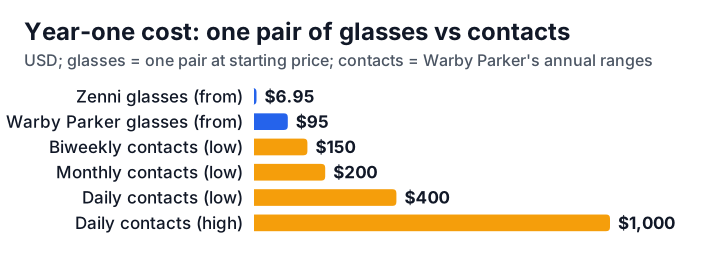
Contacts are priced per year, glasses per pair, so we lined them up with explicit assumptions. Every number comes from a published source.
Assumptions
- Glasses: one pair bought in the year, at the starting prices we published on November 4, 2026: $6.95 at Zenni (its headline price; lens upgrades are priced at checkout) and $95 at Warby Parker (prescription lenses included). Our sources don’t say how long a pair lasts, so we count one pair and don’t spread the cost over several years.
- Contacts: Warby Parker’s own annual ranges for wearing lenses in both eyes. Its daily range assumes lenses for near- or farsightedness, and it says you can stay at the lower end by buying 90-packs of lenses like Scout by Warby Parker. We have no per-box prices from the sources, so we don’t build a box-by-box figure.
- Biweekly and monthly lenses need solution and cases, which Warby Parker says to budget extra for. We have no price for them, so the ranges below are understated for those types.
- Exams, shipping and discounts are left out. Astigmatism or presbyopia lenses cost more, per Warby Parker.
| Option | Arithmetic | Year-one total |
|---|---|---|
| One Zenni pair | $6.95 | $6.95 |
| One Warby Parker pair | $95 | $95 |
| Biweekly contacts | $150 to $600 | $150–$600 |
| Monthly contacts | $200 to $600 | $200–$600 |
| Daily disposable contacts | $400 to $1,000 | $400–$1,000 |
| Both: Zenni pair plus dailies (low end) | $6.95 + $400 | $406.95 |
| Both: Warby Parker pair plus dailies | $95 + $400 to $95 + $1,000 | $495–$1,095 |
Swipe to see the full table →
If your prescription is out of date, add an exam. Glasses.com says it can arrange a $50 exam through partners, and Clark.com put Costco exams at roughly $79 to $100 in 2024. Contact wearers also need a fitting, per the NEI and Warby Parker, and we haven’t found a published price for it.
Two promotions were live on November 6, 2026, and change often: Warby Parker offered 20% off a first contacts order plus a $50 eyewear credit with an annual supply, and Lens.com said $15.99 (down from $30) to renew a prescription online. Confirm the current terms before you order.
For frame-by-frame glasses prices see how much prescription glasses cost and our price tracker.
Prescriptions: not the same paper
Warby Parker says glasses and contact prescriptions are not the same, and that you need an eye exam including a contact lens fitting to know which type and size is right. The NEI adds that, when you want contacts, your eye doctor puts trial lenses on your eyes to check the fit and test your vision. Warby Parker says a contact prescription should name a specific brand and lens type, and that many optometrists have trial lenses so you can try them before committing to a full order.
Buying online: Warby Parker asks for your latest prescription plus a copy (a photo works) or your eye doctor’s details. Lens.com says by law it must verify your prescription with your provider, who has 8 business hours to respond, and that if they don’t, it assumes the prescription is valid. Our sources don’t say how long a prescription stays valid, so check with your eye doctor.
Safety and care (from the NEI)
The NEI describes contacts as thin lenses that sit on the cornea and correct vision “just like eyeglasses.” It adds: “Contact lenses are not risk-free.” If you don’t use them the right way, you can get serious eye conditions, including corneal ulcers and infections. The NEI lists these ways to lower risk:
- Disinfect and store your contacts correctly every time.
- Wear them only for the amount of time your doctor recommends.
- Take them out before you shower, swim, or go in a bath or hot tub. Never use water to clean or store them. If water gets on them, throw them away or disinfect them overnight in solution.
- Use contact lens solution, never water or saliva, and never “top off” old solution with new.
- Replace your lens case at least once every 3 months.
- Don’t sleep in daily-wear lenses. Extended wear lenses can stay in overnight for up to 30 days and nights depending on the brand, though the NEI says they may make serious infection more likely.
Take your contacts out if you have eye pain, red eyes, light sensitivity, sudden blurry vision, unusually watery eyes or discharge, the NEI says; if symptoms don’t go away or get worse, call your eye doctor. Single-use lenses are worn for one day, thrown away at night and need no cleaning. Reusable lenses are replaced after 7 to 30 days depending on the brand, and need cleaning every day.
The NEI also says wearers should get an eye exam at least once a year.
Using both glasses and contacts
You don’t have to choose one. The NEI notes that people who wear contacts can wear non-prescription sunglasses to protect their eyes from UV, so glasses or sunglasses can sit alongside contacts. Warby Parker pairs the two in an offer: a $50 eyewear credit when you order an annual contacts supply (on November 6, 2026). If you try contacts, ask your eye doctor which type fits your routine.
How we checked
We read the NEI contact lens page (last updated December 5, 2024 on the page) and the Warby Parker and Lens.com contacts pages on November 6, 2026. Glasses prices come from our own earlier guides, checked on November 4, 2026 (and the glasses tracker, November 2, 2026), against each store’s website. Two extra pages we tried to read (an FTC and an FDA page) did not load, so nothing here relies on them. We did not buy glasses or contacts, did not wear them and did not interview doctors; this is a price and policy survey plus a summary of public health guidance, not clinical advice. Some stores pay us a commission if you buy through our links; that doesn’t change what we publish.
Check Warby Parker's current contacts and glasses pricesRelated: How much do prescription glasses cost? · Online glasses price tracker · How to read your glasses prescription
Key takeaways
- Warby Parker says daily disposable contacts for both eyes run roughly $400–$1,000 a year, biweekly $150–$600 and monthly $200–$600; glasses are advertised from $6.95 at Zenni (lens upgrades extra) and $95 at Warby Parker including prescription lenses.
- The cost types differ: glasses are mostly a one-time purchase, while contacts are a yearly supply. Our sources don't say how long a pair of glasses lasts, so the example counts one pair.
- The National Eye Institute says contacts can be a safe and effective alternative to glasses if used the right way, but they are not risk-free: improper use can cause corneal ulcers and infections.
- A glasses prescription is not the same as a contact lens prescription; contacts need a fitting as part of an eye exam, and the NEI says wearers should have an exam at least once a year.
Frequently asked questions
Is it healthier to wear glasses or contacts?
The sources we read don't rank one above the other. The National Eye Institute says contacts can be a safe and effective alternative to glasses if you use them the right way, and that they are not risk-free: corneal ulcers and infections can follow improper use. Ask your eye doctor which option fits your eyes.
Is it better to get glasses or contact lenses?
It depends on how you live and what your eye doctor recommends. The NEI notes that contacts stay in place, improve side vision and don't fog up, while contacts also need daily care or daily replacement and a yearly eye exam. Cost differs too: see the worked example above.
Can I convert my contact prescription to glasses (or the reverse)?
Not by simply copying it. Warby Parker says glasses and contact prescriptions are not the same, and that you need an eye exam that includes a contact lens fitting to know which type and size is right. Your eye doctor can tell you what each prescription should be.
How much do contacts cost compared with glasses?
Warby Parker estimates roughly $400–$1,000 a year for daily disposables in both eyes, $150–$600 for biweekly and $200–$600 for monthly lenses. On November 4, 2026, glasses were advertised from $6.95 at Zenni (lens upgrades priced at checkout) and $95 at Warby Parker including prescription lenses. Those are starting prices, and a pair is not an annual cost.
Can I wear contacts while I sleep?
Not daily-wear lenses. The NEI says it's not safe to sleep in daily lenses and that it can put you at risk of serious eye infections. Extended wear lenses can be worn overnight for up to 30 days and nights depending on the brand, but the NEI says they may make serious infection more likely. Follow your eye doctor's advice.
Do I need a prescription to order contacts online?
Yes. Warby Parker says all you need is your most recent contact lens prescription from an eye doctor, and Lens.com says that by law it must verify your prescription with your eye care provider. Lens.com also says federal law requires your eye care provider to give you a copy of your prescription.