Glasses Frame Size Guide (2026): How to Read the Numbers on Your Frames and Pick a Size Online
What the three numbers inside your glasses arm mean (lens width, bridge, temple), how small/medium/large differ between Zenni, EyeBuyDirect and GlassesUSA, and how to choose a size online.
Disclosure: We may earn a commission if you buy through links on this page, at no extra cost to you. It never affects our ratings. How we make money.
On this page
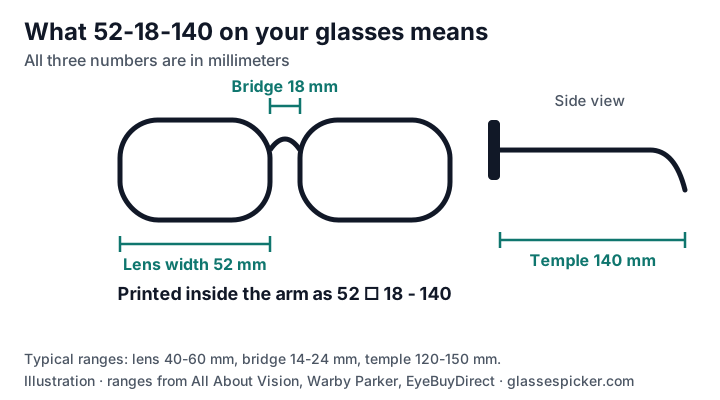
Short answer: Look inside the arm of glasses that fit you. You will usually see three numbers such as 52□18-140: lens width (52 mm), bridge width (18 mm) and temple length (140 mm). When you shop online, filter for frames within about 2 mm of your lens width and bridge, and with the same or similar temple length. Ignore “small/medium/large” labels – each store defines them differently.
Sources: All About Vision (reviewed by an ABOC-certified optician), Warby Parker, and the sizing pages of Zenni, EyeBuyDirect and GlassesUSA, all checked October 22, 2026.
The three numbers on your glasses
The numbers are printed on the inside of one temple arm (sometimes on the bridge). A small square (□) or a dash often separates the first two. All three are in millimeters.
| Number | What it measures | Typical range | Example |
|---|---|---|---|
| 1. Lens width (eye size) | Horizontal width of one lens at its widest point | 40–60 mm | 52 |
| 2. Bridge width | Gap between the two lenses, where the frame sits on your nose | 14–24 mm | 18 |
| 3. Temple length | Arm length from the hinge to the tip, including the bend behind the ear | 120–150 mm | 140 |
Swipe to see the full table →
Ranges from All About Vision, Warby Parker and EyeBuyDirect, checked October 22, 2026. Common temple lengths are 135, 140, 145 and 150 mm. Any extra letters or words printed nearby are usually the model name and color code.
Two measurements are usually not printed but appear on product pages:
- Total frame width – the full width across the front, typically about 125–150 mm (Warby Parker). This is the best single number for matching your face width.
- Lens height – the vertical height of the lens, typically about 32–38 mm. It matters most for progressives and bifocals; Warby Parker notes multifocal lenses need at least 30 mm. See our progressive glasses guide.
“Medium” means different things at different stores
This is the most common sizing mistake when buying online. Each store maps lens width to its own size labels:
| Size label | Zenni (lens width) | EyeBuyDirect (lens width) | GlassesUSA (lens width) |
|---|---|---|---|
| Extra small | Under 46 mm | – | – |
| Small | 47–49 mm | 50 mm or less | 42–48 mm |
| Medium | 50–53 mm | 51–54 mm | 49–52 mm |
| Large | 54–56 mm | Over 55 mm | 53–58 mm |
| Extra large | 57 mm and up | – | – |
Swipe to see the full table →
From each store’s sizing page, checked October 22, 2026.
A 50 mm lens is “Medium” at Zenni and “Small” at EyeBuyDirect. A 53 mm lens is “Medium” at Zenni and “Large” at GlassesUSA. Shop by millimeters.
GlassesUSA also lists bridge and temple ranges for its brackets: small 16–17 mm bridge / 130–135 mm temple, medium 18–19 mm / 136–140 mm, large 20–22 mm / 141–150 mm. Zenni suggests going one size smaller if your bridge is 15 mm or less, and one size larger if it is 19 mm or more. For wraparound and sport frames, Zenni sizes by total frame width instead.
How to pick a frame size online
- Start from a pair that fits. Copy its three numbers. This is the most reliable method.
- Match lens width and bridge within about 2 mm. A couple of millimeters either way usually feels similar, but frame shape matters too – All About Vision notes two frames with the same numbers can fit differently.
- Compare total frame width if the product page lists it. Measure the front of your current glasses straight across, hinge to hinge, and compare.
- Keep the temple length close. The arms should reach behind your ears without sticking out far past them.
- No glasses to copy? Use a size tool (Zenni’s Find My Size or GlassesUSA’s size finder), or try the credit-card check below.
Face-width tips
- Frame width: EyeBuyDirect advises a frame slightly wider than your face, with no more than about a finger’s width between the temple arm and the side of your head.
- Eyes centered: Warby Parker suggests your eyes should sit roughly in the middle of each lens.
- Bridge: narrower noses generally suit narrower bridges, and wider noses suit wider bridges.
- Credit-card check (Warby Parker): hold a standard card’s 54 mm edge under one eye, starting at the center of your nose. If the card goes past the outer edge of your eye, try narrower lenses; if it ends right at your eye’s edge, a medium width should work; if it stops short, try wider lenses.
Frame size is not your PD
Frame size describes the glasses. Pupillary distance (PD) is the distance between your pupils, and the lab uses it to center each lens in front of your eye. You need both to order online, plus your prescription:
- How to measure your PD
- How to read your glasses prescription
- Best glasses for your face shape – which frame styles retailers suggest for each face shape
Verdict
The three numbers inside your current glasses are the best fit guide you have. Copy them, shop within about 2 mm on lens width and bridge, and ignore size labels, which do not match from one store to the next. If you are unsure, choose a store with a longer return window – compare them in our guide to the best places to buy glasses online.
Once you know your size, compare brands in our best glasses frame brands guide.
Once you have your measurements, budget partner Lensmart lists frames from $6.95. See Lensmart glasses
Key takeaways
- The three numbers inside your glasses arm are lens width, bridge width and temple length, in millimeters – for example 52-18-140.
- Typical ranges are 40–60 mm for lens width, 14–24 mm for the bridge and 120–150 mm for the temple.
- Size labels are not standard: a 50 mm lens is 'Medium' at Zenni but 'Small' at EyeBuyDirect, so shop by millimeters, not by label.
- The easiest way to get a good fit online is to copy the numbers from a pair that already fits and stay within about 2 mm on lens width and bridge.
- Frame size and pupillary distance (PD) are different measurements; you need both to order online.
Frequently asked questions
What do the numbers on my glasses mean?
They are lens width, bridge width and temple (arm) length, all in millimeters. In 52□18-140, each lens is 52 mm wide, the gap between the lenses is 18 mm, and each arm is 140 mm long.
What is a medium frame size?
It depends on the store. Zenni calls a 50–53 mm lens width medium, EyeBuyDirect uses 51–54 mm, and GlassesUSA uses 49–52 mm. Compare the millimeter numbers rather than the size label.
How do I know my frame size without old glasses?
Use a store's size tool (Zenni and GlassesUSA both offer size finders), or try a frame in a shop and note its numbers. A quick check from Warby Parker: hold a credit card's 54 mm edge under one eye, starting at the middle of your nose – if it extends past your eye, try narrower lenses; if it falls short, try wider ones.
Is frame size the same as PD?
No. Frame size describes the glasses; pupillary distance (PD) is the distance between your pupils and tells the lab where to center each lens. You need both for an online order.