Reading Glasses Alternatives (2026): Better Ways to See Up Close
Alternatives to buying dedicated reading glasses: progressive lenses from a $37.95 add-on, one pair for distance and close-up, screen-specific blue light lenses, or a $6.95 baseline pair to test the idea. All prices verified.
Disclosure: We may earn a commission if you buy through links on this page, at no extra cost to you. It never affects our ratings. As an Amazon Associate I earn from qualifying purchases. How we make money.
On this page
Short answer: Most people searching for a reading glasses alternative want one of three things: to stop swapping pairs (progressives), to fix screen-time eye strain (blue light options), or simply to pay less than the drugstore price (online readers from $6.95). This guide prices each route with verified store listings — checked November 8–14, 2026 — and says when a plain cheap reader is still the honest answer.
Lensmart and SOJOS are affiliate partners and we earn a commission if you buy through our links; Readers.com, Zenni and Warby Parker are not partners and get no buttons. Nothing here is hands-on — every figure is a maker or store listing with its check date. See how we review.
Alternative 1: Progressives — one pair instead of two
If you wear distance glasses, the real “alternative to reading glasses” is a lens, not a product: progressive lenses carry distance and near zones in one surface, at the cost of adaptation time and a higher price. Zenni lists its progressive lens options at $37.95 and $52.95 on top of a frame, and its own frames start at $6.95 (both November 9, 2026) — so a complete Zenni progressive pair starts far below optical-store prices. Whether progressive or lined bifocal suits you better is compared in bifocal vs progressive glasses.
Alternative 2: Fix the screen problem instead
If your near blur shows up mostly at a monitor, two things compete with plain readers:
- Prescription blue light lenses combine magnification (or your distance Rx) with a filter — Lensmart takes prescriptions across its budget frames.
- Non-prescription blue light frames like SOJOS’s collection ($29.99–$49.99, checked November 14, 2026) style for screens but add no power — they are not a reading substitute if you actually have presbyopia.
What the filtering claims do and do not promise is broken down in are blue light glasses worth it.
Alternative 3: Just pay less for the readers
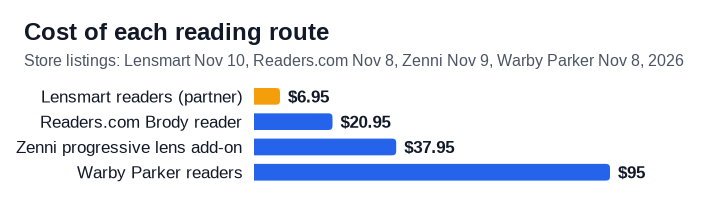
Sometimes the alternative is a cheaper version of the same thing. Verified November 8–10, 2026: Lensmart’s reading collection runs $6.95–$24.95; Readers.com’s Brody reader lists at $20.95 (other styles $23 and $28); Warby Parker’s readers sit at $95. At those prices a baseline pair is a reasonable experiment before any lens upgrade — the full cost table with shipping and returns is in reading glasses cost, and model picks are in best reading glasses.
Which route fits you
- Distance glasses wearer, near blur arrived → progressives added to your next pair; budget route is a $37.95-class add-on.
- Screens are where it hurts → check whether it is fatigue or presbyopia first; blue light filtering is a feature, not a fix for blur.
- Occasional reader, no other glasses → a $6.95-class pair from the reading collection is the cheapest honest test.
- Reading power plus sun → prescription sunglasses or a clip-on beat carrying readers everywhere; see prescription sunglasses vs transition lenses.
Related: Reading glasses cost · Best reading glasses · Bifocal vs progressive · Blue light glasses worth it · Glasses price tracker
How we checked
Lensmart reading-collection prices were verified November 10, 2026; Zenni progressive and returns terms November 9; Readers.com and Warby Parker reader prices November 8 via our own best reading glasses evidence; the SOJOS blue light collection was re-checked November 14, 2026. No product was used, no review scores are quoted, and partner products follow the same rules as non-partners. Broader question: glasses alternatives covers all four routes beyond reading.
Key takeaways
- A dedicated pair of readers is the cheap baseline, not the goal: Lensmart lists reading frames from $6.95 to $24.95 (Nov 10, 2026), Readers.com's Brody reader at $20.95 (Nov 8), Warby Parker's readers at $95 (Nov 8).
- The main alternative is one pair that does both: progressive lenses added to a frame — Zenni lists progressive lens options at $37.95 and $52.95 (Nov 9, 2026) — so you stop swapping glasses.
- If your close-up strain is mostly screens, a prescription blue light lens or a non-prescription blue light frame (SOJOS lists them from $29.99, Nov 14) may fit better than plain readers.
- We have not tested any of these; every figure is a store listing with its check date, and Lensmart is our affiliate partner.
Frequently asked questions
What is the best alternative to reading glasses?
If you already wear distance glasses, progressive lenses turn that one pair into a reading pair too — Zenni lists progressive options at $37.95 and $52.95 (November 9, 2026). If you do not wear glasses otherwise, a cheap dedicated pair (from $6.95 at Lensmart) is the low-risk way to test whether magnification solves your problem before paying for a custom lens.
Are progressives better than separate reading glasses?
They solve a different problem. Progressives give you distance, intermediate and near vision in one lens but take adaptation and cost more; dedicated readers are cheap, instant and fine for occasional use. The trade-offs are compared in our bifocal vs progressive guide.
How much do reading glasses cost, anyway?
Verified November 8–10, 2026: Lensmart reading frames $6.95–$24.95, Readers.com's Brody reader $20.95 (other styles $23 and $28), Warby Parker readers $95. Our reading glasses cost guide has the full seven-tier table with shipping and returns.
Do blue light glasses replace reading glasses?
Only if your close-up blur is fatigue rather than presbyopia — and only an eye exam tells you that. Blue light filtering is a lens feature, not magnification; it can be combined with reading power or prescription lenses. See our blue light glasses guide for what the filtering claims actually say.
- Lensmart – Reading glasses collection (frames $6.95–$24.95, checked Nov 10, 2026)
- Zenni – Progressive lenses and returns (checked Nov 9, 2026)
- Readers.com – Brody reader pricing (checked Nov 8, 2026, via our best reading glasses guide)
- Our own guide – Best reading glasses (Readers.com and Warby Parker prices, Nov 8, 2026)
- Our own guide – Bifocal vs progressive glasses