How Much Do Progressive Lenses Cost? Standard vs Premium Prices Online and In-Store (2026)
What progressive lenses cost at Zenni, EyeBuyDirect, Warby Parker, LensCrafters, Target Optical and others, how standard, premium and freeform designs differ, and when paying more makes sense – checked against each store's own site.
Disclosure: We may earn a commission if you buy through links on this page, at no extra cost to you. It never affects our ratings. How we make money.
On this page
Short answer: progressive lenses cost anywhere from under $40 online to $600–$800 for premium lenses in a shop, depending on where you buy and which design you pick. Online stores list the lowest numbers: Zenni from $37.95 (standard) or $52.95 (premium) plus the frame, and EyeBuyDirect from $49 on eligible frames. Warby Parker’s progressives start at $295, and All About Vision (updated March 2026) lists $175–$250 for standard progressive lenses and $600–$800 for premium or custom designs, lenses only. Frames are extra in most of these quotes, and the quotes are not all measured the same way, so read the table below before you compare.
We read each store’s own lens and pricing pages on November 4, 2026. Several big chains (LensCrafters, Glasses.com, GlassesUSA) don’t print a progressive price online, and we say so rather than guess.
Progressive lens prices by store
The most important thing in this table is the basis column. Some stores price the lens on top of a frame; some quote a starting price for a finished pair; some don’t publish a price at all.
| Store | Progressive tiers named on site | Advertised starting price | Basis |
|---|---|---|---|
| Zenni | Standard; Premium; Near-range and Mid-range Workspace | $37.95 standard and workspace; $52.95 premium | “Lens pricing starts at” – lens only, frame extra |
| EyeBuyDirect | Standard, Premium, KODAK IntroPlus, KODAK IntroMax | $49 | “Customize eligible frames with progressive lenses starting at $49”; per-tier prices not shown |
| Warby Parker | Signature; Precision | $295 Signature; $395 Precision | Progressives page: “start at $295” / “starting at $395”, frame inclusion not stated; its lens guide says premium progressives “start at $395, and that includes both frames and lenses.” Both lines are digital free-form with coatings |
| Target Optical | Not named | Not listed online | Prescription glasses from $79 with single-vision lenses; progressive pricing at checkout or by phone |
| LensCrafters | LensCrafters Adaptive Progressive | Not listed online | Page lists “Frame + lenses starting at $99” in general offers, not tied to progressives |
| GlassesUSA | Standard (“progressive”) and Premium | Not listed on category page | Prices shown for your frame at checkout |
| Glasses.com | Not named | Not listed | Its blog says the average cost of progressive lenses is $150–$250 (Jan 2026) |
| Otra | – | Doesn’t list progressives on its homepage | Frames shown at $65–$75 |
Swipe to see the full table →
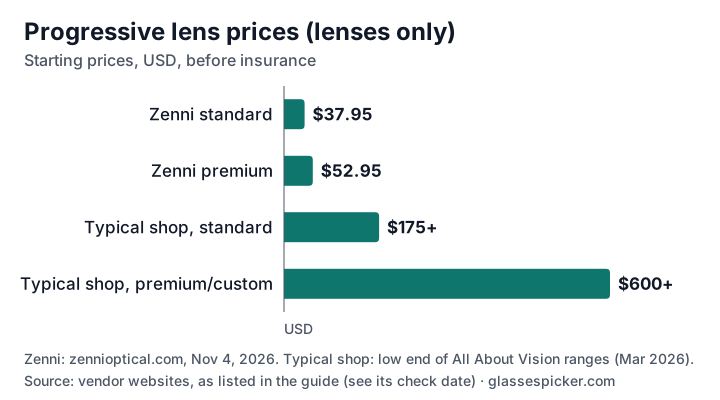
Two things stand out. First, the gap between online and in-store is large, but it’s a gap between different services: online stores sell you a lens to match a prescription and PD you supply, while Warby Parker and the chains add in-person measurement and staff. Second, the stores that sell by “starting at” prices rarely show what you’ll pay once you add a thin material, anti-reflective coating or light-adjusting lenses. Zenni, for instance, lists Transitions and Blokz blue-light filtering as add-ons without prices on its progressive page.
For Costco, which sells its Kirkland Signature progressive in the warehouse and doesn’t publish the price online, see our Costco glasses vs buying online guide. For store-by-store picks and return windows, see best progressive glasses online.
Standard vs premium vs freeform: what you’re paying for
Retailers use these words loosely, so here is what the independent and manufacturer sources actually say.
Standard progressives give distance, intermediate and near vision in one lens. They’re the entry point for most online stores. Zenni describes its standard version as comfortable, balanced vision. All About Vision says standard progressive lenses typically have a smaller reading area and more peripheral blur or “swim effect” than higher-end designs.
Premium progressives are designed for wider usable zones and less peripheral distortion. All About Vision says premium lenses have wider optical zones, less peripheral distortion and smoother transitions between powers. Zenni says its premium line is built for easier adaptation and wider viewing areas than its standard one.
Freeform (also called digital or custom) progressives are made by computer-controlled surfacing rather than conventional tooling. All About Vision says this allows power control in steps of 0.01 diopter, compared with 0.125 to 0.25 diopter with conventional tooling, and a design that can account for how the lens sits in the frame and where your pupil sits. It adds that the benefits are potential, not guaranteed, and that these lenses may cost more than conventional lenses of the same material and design. Warby Parker says both of its progressive lines are digital free-form lenses, and that its Precision line is aimed at superior visual quality and reduced peripheral distortion. Terms differ by store, so check what the product page actually describes.
Specialty designs are priced higher still. All About Vision lists computer progressives at $150–$250, short-corridor designs (made for smaller frames) at $250–$400 and ground-level designs at $350–$550, all lenses only.
Where Varilux, ZEISS and HOYA fit
These three companies make branded progressive lenses that eye doctors and opticians order for you. Their own sites describe the pitch: ZEISS says its Individual lenses are fitted to the wearer’s visual behavior, facial anatomy and chosen frame, and claims SmartLife Individual 3 offers up to 29% wider fields of view than SmartLife Superb (a ZEISS claim). HOYA’s patient page talks about personalization, a wider range of vision and smoother adaptation across its lines. Essilor’s Varilux X series page gives no figures we can cite.
None of the three publishes a consumer price. The ZEISS and HOYA professional and patient pages we read list no prices, and neither does Essilor’s Varilux X series page. A branded lens at a shop is priced by that shop, so ask for a written quote, and ask what the same shop charges for its own-brand freeform alternative before you decide.
Is it worth paying more?
It depends on three things.
1. How much more you’d pay. At Zenni the step from standard to premium is $15 ($37.95 to $52.95). That’s a small bet. At a shop where premium or custom lenses run $600–$800 against $175–$250 for standard (All About Vision’s ranges), the question is whether the extra width and comfort are worth several hundred dollars to you.
2. Your prescription and frame. All About Vision notes that people with higher refractive errors may notice more benefit from freeform lenses. Small frames also reduce the room for the reading zone; EyeBuyDirect says its premium progressives support smaller frame styles. If your prescription is strong or you want a small frame, ask your eye doctor what design suits you.
3. Whether it’s your first pair. Zenni’s blog says adjustment can take a few days or even a couple of weeks and, per All About Vision, symptoms of adjustment tend to resolve within a few weeks of continued wear. A first pair is where in-person measurement and adjustment are most useful. The American Academy of Ophthalmology has noted that a small PD error can cause problems with progressives, as we explain in best progressive glasses online.
A simple rule: if you’ve worn progressives before, have a current prescription and PD, and want to save money, an online premium or freeform option is a reasonable try. If it’s your first pair, or your prescription is complex, a store fitting is worth paying for.
When an in-store fitting is the better choice
- You’re new to progressives and want help with frame height and adjustment.
- You want to try on the frame with the lens design you’re buying.
- You’d rather return to the same place for adjustments than ship glasses back.
Warby Parker and LensCrafters sell online and in stores, and Target Optical’s pages route progressive pricing through checkout or a phone call. If you’re comparing multifocal types first, our bifocal vs progressive glasses guide covers the differences.
How to pay less for progressives
- Start with the online step-up. The cheapest published progressive prices are online. Compare the lens-only prices in the table, then add the frame.
- Use vision insurance if you have it. Many plans give a lens allowance, and some stores apply it at checkout while others reimburse you. See using vision insurance for glasses online.
- Pay with FSA or HSA funds. Prescription glasses are eligible medical expenses; details in FSA/HSA for glasses online.
- Only add what you need. Coatings and light-adjusting lenses raise the total. See is anti-reflective coating worth it and Transitions vs photochromic lenses.
- Check high-index pricing. Strong prescriptions may need thinner lenses; see our high-index lenses guide.
- Keep the return window in mind. A cheap progressive you can’t adapt to is not a saving.
If you want to price an online pair, EyeBuyDirect lists progressives from $49 on eligible frames.
EyeBuyDirect
Online progressive optionBest for: Comparing standard, premium and KODAK progressive lenses online
- Progressives from $49 on eligible frames
- Four progressive lens options listed
- Includes KODAK IntroPlus and IntroMax lines
- Per-tier lens prices not shown on the progressive page
- No in-person fitting
How we checked
This guide is based on a review of each retailer’s public website on November 4, 2026, plus the named independent and manufacturer sources in the list at the top. We did not buy or wear any of these lenses, and we have not tested them. Where a store doesn’t publish a progressive price, we say “not listed” rather than estimate. Prices change and are often tied to promotions, so check the store’s page before you order. Third-party price ranges (All About Vision, Glasses.com blog) are general US figures and not store quotes.
Key takeaways
- Online, Zenni lists progressive lenses from $37.95 (standard) and EyeBuyDirect from $49 on eligible frames; Warby Parker lists progressives from $295, and All About Vision puts standard progressive lenses alone at $175–$250 (March 2026).
- Premium and freeform designs are made around your measurements and are meant to give wider usable zones and less peripheral distortion; All About Vision puts premium/custom lenses at $600–$800 (lenses only).
- Brand lenses such as Varilux, ZEISS and HOYA are sold through eye doctors and opticians; their makers do not publish consumer prices, so ask for a quote.
- Zenni's premium progressive costs $15 more than its standard one ($52.95 vs $37.95), so the online step-up is small.
- Your first pair, a strong prescription or a hard-to-fit frame are the cases where an in-person fitting can justify a higher price.
Frequently asked questions
How much do progressive lenses cost?
It depends on where you buy. Online, Zenni lists progressive lenses from $37.95 (standard) and $52.95 (premium) plus the frame, and EyeBuyDirect from $49 on eligible frames. Warby Parker lists progressives from $295 (Signature) and $395 (Precision). All About Vision (March 2026) gives $175–$250 for standard progressive lenses and $600–$800 for premium or custom ones, lenses only, before insurance.
Are premium progressive lenses worth it?
Often, if you can get them at a modest step-up. Premium and freeform lenses are designed to give wider usable zones and less peripheral distortion than basic designs, according to All About Vision. At Zenni the step-up is $15; in a shop it can be several hundred dollars, so compare what the extra buys you and ask your eye doctor about your prescription.
What is the difference between standard and freeform progressive lenses?
Freeform (digital) lenses are shaped with computer-controlled surfacing, which All About Vision says allows finer power control (0.01 diopter steps versus 0.125 to 0.25 for conventional tooling) and a design that can take frame fit and pupil position into account. Standard designs are more basic.
Do Varilux, ZEISS and HOYA progressive lenses cost more?
Usually, but their makers do not publish consumer prices; the retailer sets them. Ask the optician for a written quote for the specific lens line, and for a comparison with the shop's own-brand option.
Can I use insurance or FSA money on progressive lenses?
Prescription glasses are eligible medical expenses for FSA/HSA under IRS rules, and many vision plans give an allowance toward lenses. Coverage depends on your plan, so check it before ordering.
- Zenni – Progressive lenses
- EyeBuyDirect – Progressive glasses
- Warby Parker – Progressive lenses
- Warby Parker – Eyeglasses lens guide
- Target Optical – Lens options
- Target Optical – Homepage
- LensCrafters – Lenses
- LensCrafters – Adaptive progressive lenses
- GlassesUSA – Progressive lenses
- Glasses.com – How much do glasses cost (Jan 29, 2026)
- Otra Eyewear – Homepage
- All About Vision – Progressive glasses: no-line multifocals (updated Mar 2, 2026)
- All About Vision – High-definition eyeglass lenses
- American Academy of Ophthalmology – Does pupillary distance have to be exact?
- Zenni – Premium vs standard progressive
- ZEISS – Progressive lenses (eye care professionals)
- IRS Publication 502 – Medical and dental expenses (eyeglasses)
- Essilor – Varilux X series
- HOYA Vision – Progressive lenses (patients)